

The Mindfulness Skill Behind Working Well With AI
Full Webinar Link: https://vimeo.com/1204934204/c0da6eb664?share=copy&fl=sv&fe=ci
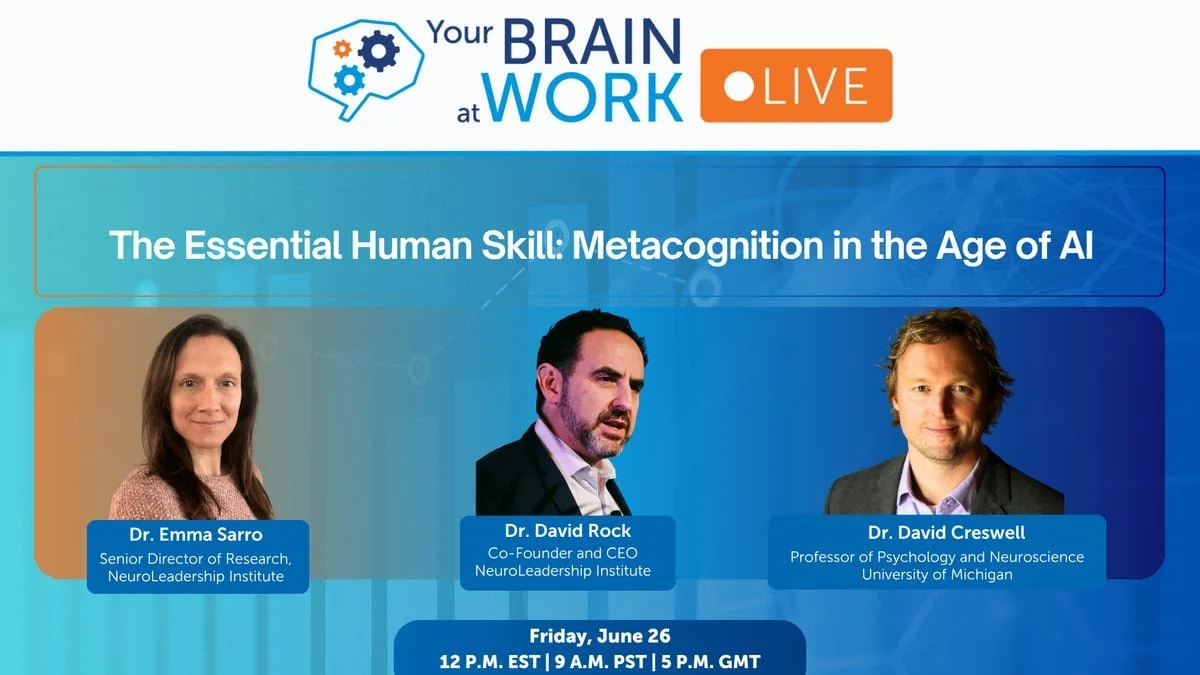
Equa co-founder and Chief Science Officer Dr. David Creswell, a professor of psychology and neuroscience at Carnegie Mellon University, joined Dr. David Rock, co-founder of the NeuroLeadership Institute, on the Institute's Your Brain at Work Live for a conversation about metacognition, mindfulness, and what it takes to use AI well. One idea ran through all of it: the mental skill you build in meditation is closely tied to the one that helps people work well with these tools.
Summarized Transcript
Dr. Emma Sarro: Welcome back to Your Brain at Work Live. Today we dig into the science of mindfulness and how it supports our metacognitive abilities, one of the critical skill sets for working with AI.
My first guest is a professor of psychology and neuroscience at Carnegie Mellon University. His work focuses on how people adapt and thrive under stress, with an emphasis on the mind-body connection and pathways to resilience, including work on mindfulness and self-affirmation. He received early career awards from the American Psychological Association and the Social Personality Health Network, and was named a rising star by the Association for Psychological Science. His work has been profiled by outlets including The New York Times, the LA Times, and the Today Show. Welcome, Dr. David Creswell.
Dr. David Creswell: Thanks for having me.
Dr. Emma Sarro: My second guest coined the term "neuroleadership" when he co-founded NLI more than two decades ago. He holds a professional doctorate, has written four books, and has bylines ranging from the Harvard Business Review to The New York Times. Welcome to our co-founder and CEO, David Rock. To start, Dr. Creswell, tell us about your research and the work we've done together.
Dr. David Creswell: It has been a good run. We have worked together for many years, and it has been my pleasure to grow my own career alongside the different programs NLI offers. I have participated in a couple of summits and collaborated in other ways, co-developing and testing ideas, and I take a lot of that feedback and plug it into future research.
Broadly, my work focuses on stress and resilience, and on understanding what makes for more resilient individuals and more resilient organizations. We use stress management strategies and interventions as a tool for probing resilience, and the work falls into a couple of buckets. One is how these processes play out in our biology: how they change our brains, our stress responses, and stress-related health outcomes over time. A lot of my early work was on that biological embedding, including neuroimaging and peripheral stress physiology.
Over the last eight years or so we have focused on the psychological and behavioral processes that kick off those biological effects. What is it that people are actually learning in meditation programs? We have concentrated on acceptance and equanimity, the capacity to be both metacognitive and non-reactive to your experiences. Each time you observe your thoughts and feelings without reacting to them, you are doing what I call an equanimity rep, much like a curl at the gym. Those reps recalibrate how you respond to challenges instead of just emotionally reacting. Like many scientists, I am now thinking about scaling. If these interventions work, how do we scale them for people's busy everyday lives? So we are working with a new meditation app and doing other work in the implementation science space.
What metacognition is
Dr. David Rock: I have always been passionate about making mindfulness as secular as possible, because a lot of people equate it with something new age or religious or soft, when in fact it is a brain capacity. That matters even more now, because being able to reflect on your thinking might be one of the most important capabilities for using these new technologies. So talk to us about metacognition. What is it in the brain? Is it a state or a trait?
Dr. David Creswell: Metacognition has a new buzz to it with all these AI technologies challenging these skills. It is fun for me, because mindfulness is a metacognitive capacity, and that is how we have talked about it for years.
Put directly, metacognition is thinking about thinking. It is the capacity to monitor and control your own mental processes. Most of the time we live inside our thoughts and feelings. You have the thought, "I am so stressed right now," and you are just caught inside that experience. Metacognition is the ability to be aware that you are having the thought, to step back from the experience. Some people do this all the time; others barely do it at all. There is a huge range.
Critically, the very best treatment programs we have, whether good psychotherapy, a good meditation program, or journaling and expressive writing, all ask us to step back, observe our thoughts and feelings, and reconsider how we relate to them. Our best evidence-based treatments are really about developing these metacognitive skills.
Dr. Emma Sarro: This connects to so much of what we have discussed on the power of understanding your own brain. Being metacognitive about why you are thinking about something, where a thought comes from, and how you reached a conclusion helps with resilience and with the healthy mind platter model. Now we face the challenge of learning these new AI tools, and we need to replay those same skills. Here we are again.
What the brain tells us
Dr. David Rock: What do we know about the brain processes involved? I know it is not one network.
Dr. David Creswell: I am not a fan of locating processes in one spot, but the metacognition literature has converged to some extent on the prefrontal cortex, particularly the anterior regions, the most highly evolved, human-centric parts of the brain. A 2018 meta-analysis of 47 neuroimaging studies found that these metacognitive processes are largely localized in anterior prefrontal cortex, with dorsolateral and ventrolateral involvement depending on the demand.
There is also the affect labeling work from Matthew Lieberman and others. If you label an experience linguistically while in the scanner, anger or fear or whatever it is, that reliably activates the prefrontal cortex, especially right ventrolateral prefrontal cortex. And labeling does not just turn that region on. It turns down the brain's threat response, quieting the amygdala and other regions that coordinate alarm reactions. Putting feelings into words is part of why psychotherapy works.
On the structural side we see the same pattern. People with more metacognitive ability show greater white matter integrity and stronger connecting tracts in anterior prefrontal cortex. A Fleming paper from 2010 in Science used a performance task where everyone performed the same, but some people made accuracy ratings about their own performance. People who were more accurate about how they did had more gray matter volume and white matter integrity in anterior prefrontal cortex. And in lesion studies, people with damage to that region perform the same on discrimination tasks, but their perceptual metacognition is degraded. They cannot step back and evaluate their performance.
So the evidence converges across functional, structural, and lesion studies. It rarely lines up this cleanly in neuroscience, but with metacognition it does.
Dr. Emma Sarro: That speaks to the idea that you can improve over time. The brain changes with experience and practice. Some people may be more naturally metacognitive, but generally, unless you have a lesion in that area, everyone can build the skill.
Training the skill: meditation as reps
Dr. David Creswell: Let me speak to the trainable skill idea. It is reflecting on anything: feelings, thoughts, body sensations, even awareness of interpersonal dynamics. The very front of your prefrontal cortex is the orchestrator for these skills, and in today's complex world we rely on them to navigate our relationships and our organizations.
On training, I am a big proponent of meditation as a domain-general way to build this. In meditation you sit and pay attention to your experience, your thoughts and body sensations, and you observe without reacting. It is essentially a metacognitive rep machine. You observe, acknowledge, and do not get caught. Even 14 days of 10 to 20 minutes a day on a smartphone can help people focus more and avoid getting caught in their stress cycles. One of the early figures in the addiction space called it urge surfing. You notice cravings rise and fall as a metacognitive observer.
People often think meditation is supposed to be relaxing. My argument is that its intent is to make you a little uncomfortable. When you start paying attention to your breathing, suddenly you would rather be doing something else, or you feel restless. Those benign discomforts are the tools of meditation for developing metacognitive skills. Sometimes you feel calm, but ideally it is more like going to your own mental gym and doing discomfort reps. That is what translates into stress resilience.
Dr. David Rock: I see metacognition training in nearly every therapy and technique. Pull back, observe, reflect, switch. Tell us about the variability between people.
Dr. David Creswell: The literature is divided by focus. One area looks at metacognitive accuracy: how accurately do I know my own experience or performance? You see a bell-shaped curve, with a lot of variability. Interoception is another piece, the capacity to know your internal bodily states. Some people can detect their own heartbeat; others have no idea what you are talking about. Whether it is heartbeats or thoughts and feelings, there is a huge range in how accurately people can read that experience. And these new generative AI tools require a whole new set of metacognitive abilities.
The 5 percent
Dr. Emma Sarro: Why does using AI require an amped-up version of metacognition?
Dr. David Creswell: No one has yet run the studies on whether meditation or expressive writing produces skill transfer into these domains. That is a great scientific opportunity, but I believe that kind of transfer would be there.
Dr. David Rock: Let me share some data. We have been collecting data from HR leaders in North America and around the world, asking what percentage of their employees have what we call human-first AI fluency. We define that specifically: their work has clearly gotten better, meaning quality went up, or speed went up without quality dropping, or breadth went up without quality dropping, and their mental health has not degraded. Not how many people use it, which is around 60 percent of those given access, but this specific outcome. The number we are seeing globally is about 5 percent, and it is not moving fast.
When I ask what those people are like, it is not that they are the technical folks or the engineers. They often come from unrelated spaces. The common thread is that they are passionate learners with a growth mindset, and what I hear described is high mindfulness or high metacognition. They are people who spent their lives thinking about their thinking, who did work on themselves. Do we know anything about the prevalence of good metacognition in the general population?
Dr. David Creswell: Great question. I do not think scientists or public health researchers have taken that on, so we do not have good prevalence rates. It also depends how big an umbrella you make metacognition, since a lot of the work has been narrow, focused on body or memory. But I suspect you are on the front edge of something. As the need grows with AI and more complex environments, people will build domain-general measures and start mapping individual differences at a population level.
Your instinct is right. The capacity to use these tools depends on being curious, open, and wanting to be a learner, and on embracing being a generalist. These tools let you be more than a programmer. You can be a designer, an integrator, a systems thinker. You may not need specific Python programming anymore because the tools build it, so now you need to be the designer and systems thinker for new systems. That can be a real opportunity for these kinds of thinkers.
Dr. David Rock: We published an article in Fortune proposing that metacognition is the one skill that makes people generally better at this. I explained human-first AI fluency to one company, and their response was, "Yeah, we've got a guy." One person, out of thousands who had been given the tools.
Everyone had FOMO. Companies, often Microsoft shops, rolled Copilot out to everyone and encouraged use. People heard it was a tool to help them not have to think, so they used it for everything. Sometimes that is good higher-order thinking. Often it is not. It becomes an acceleration of unnecessary work, an acceleration of work slop. All these tools draw from the same database, so if you give 25 large language models the same exercise, they answer basically the same. By objective measures, most people are not doing better work, with some exceptions like AI embedded into a sales process. So companies are having a big gulp about how much they spent and how little return they are getting. Only about 60 percent use it, only about 5 percent benefit, and the average user offloading to it produces worse work with negative mental health effects. We urgently need to teach metacognition. What is the fastest way?
Dr. David Creswell: There are strong parallels. A lot of the early mindfulness app work was about handing it off to organizations, and with a pure handoff, very few people use it and even fewer benefit, because they do not stay on. White-glove approaches with coaching, support, and integration work far better. AI has the same opportunities and challenges. There is a Nature Reviews Psychology paper on how AI tools can promote learning but also create cognitive offloading that sidelines people and makes them less effective. NLI is a unique place to build the scaffolding for this, because AI places new metacognitive demands on us that we have not had to deal with before.
The metacognitive demands of AI
Dr. David Creswell: Handing someone ChatGPT, Claude, Gemini, or Copilot is like handing them a Ferrari without teaching them to drive a stick shift. It is powerful, but there is no manual. You can think about it in roughly four steps.
First, self-awareness of your own goal and the ability to decompose the task, so you can form prompts effectively. Second, the ability to iterate on your prompts conversationally, with enough confidence in your own judgment to react to the output and see how it fits your goals and your understanding of the domain. Third, the ability to evaluate the output and judge whether it is any good. This is where a lot of the sidelining happens. People think, "it probably knows more than me." You need the metacognitive and emotion-regulation ability to say, no, I am the driver, this is just the car. Fourth, deciding when and whether you should use AI at all. Some tasks it helps with, and others you do not want to get caught in automation loops. Agentic AI adds new challenges and new metacognitive skills about how you deploy agents.
Personally, I use Claude, ChatGPT, and a suite of tools in my scientific and popular writing, and I have been in the weeds with this for about a year and a half. My skills had to change. Instead of spending hours writing a single perfect paragraph, I use the tools to stitch my ideas together into a well-written paragraph. I step back and ask what the big ideas are that the paragraph needs to communicate, not how it is composed, because I can react to that once it is generated. That frees me to focus on my intentions and creative ideas. It has required me to change how I write and think, because I have to ask questions to test the tool's knowledge and collaborate in ways I did not before.
Clarity, flexibility, vigilance
Dr. David Rock: You have just made me very happy, because Emma and I reached the same conclusion. We have been thinking about the critical habits, and metacognition is the foundation. The first habit is clarity: about the task, its purpose, and whether you should even use AI. The second is flexibility, seeing things from many angles. Generative AI is fantastic at helping you be more flexible, if you are willing to ask the questions, so you can see things from your boss's or your competitor's point of view. The third is vigilance: that some portion of it is wrong, but also that all of it is average and carries bias. The wrapper around all of it is human in the lead, not human in the loop. As soon as you offload big chunks, you lose the thread.
Dr. David Creswell: So much of the job now is motivating new metacognitive habits in ourselves and our teams. In my lab we hold sessions where we talk through what prompting works and what does not, co-evolving with the tools. What is happening now looks very different from six months ago. We can treat that as a threat, or as an opportunity for growth. A lot of it is managing our own emotions, because there is a mania and a dejection, a "will I be relevant in six months," that does not help. That is why domain-general practices like meditation are so helpful. They build the capacity to hold our experience and look at our thoughts.
Dr. David Rock: The SCARF model is a labeling tool: status, certainty, autonomy, relatedness, fairness. For a lot of people, being asked to use these tools creates SCARF threats across all five domains. Metacognition is reflecting on your thoughts, and SCARF is a scaffold that helps you label what is going on. We have been building a neurointelligence framework that gives people something to be metacognitive about. The goal is to make hard thinking easier, because being this metacognitive is genuinely hard. That is my biggest takeaway from weeks on the road.
Can AI make us more metacognitive?
Dr. David Rock: Here is a contentious question. Can well-tuned, well-trained AI tools help us be more metacognitive?
Dr. David Creswell: It depends how you use them. Over the last six months I have moved toward being metacognitive about my meta questions, going meta meta. Before I build a set of goals and workflows with the AI, I ask it first: what is our best approach to this problem, give me different ideas from different perspectives. In that sense it has helped me co-evolve my own metacognitive skills.
The challenge is that being metacognitive is effortful. You can go infinitely meta and get lost in loops, because these tools are so generative. So it is also about learning to flex those skills and judge how much it is worth the squeeze for a given line of thought. The back end is getting better, too. The tools now do some of the metacognitive work for you and will surprise you. Claude surprises me with interesting questions, like "have you thought about this first?" It is a bit like finding a new collaborator with interesting ideas.
The tools have no soul
Dr. David Rock: These tools can start to feel human-like, and people are beginning to ask whether they have something like metacognition of their own. What are your thoughts on that?
Dr. David Creswell: There is a lot of space right now where these tools feel more human-like, and we want to probe that space. I see you doing what I do, testing the tool's skills, trying to break it, then using it. But these tools do not have a soul. They are never going to be human. It is easy to fall into wanting them to be human, treating them like humans, and assuming they have consciousness, and there is a real danger in that, because it leads to more offloading and, for me, to existential spin-outs. They also all have biases. A Chinese large language model is different from a North American one, with biases that are not obvious. They are helpful machines with no true soul, agency, or, in my opinion, true creativity, but they are tools for taking what you want to work on and elevating it through the right interaction.
Dr. David Rock: It is important to ask about their biases. Mainstream tools tend to bias toward agreeing with you, sometimes to the point of being sycophantic, because they are built to keep you engaged. That is a real problem when leaders use them for interpersonal questions, because the leader is often part of the problem, and mainstream AI tends to take the leader's word as gospel.
Dr. David Creswell: Great managers try to understand their employees, and good AI use is similar. You give it a lot of context: the problem from your perspective, the relevant papers. And it goes both ways. You also need to understand how the engine is constructed so you can calibrate what you ask it, and which tool to use for which purpose. No matter how good any one tool gets, people should not rely on only one. They are fit for purpose. You want some tools that disagree with you straight up front. Discernment is a big word.
Closing: better or worse?
Dr. David Rock: How has this new technology made your brain better or worse?
Dr. David Creswell: I am a pragmatic worker. I work hand in hand with these tools, but I try to enable them to be their best. I have linked my Claude tools to connectors so they reach Consensus, PubMed, and other scientific databases, so we are not hallucinating or making up science. Then the work lives in the soft metacognitive skills, figuring out the questions, rather than being buried in sentence structure. Much like when the calculator arrived and we stopped doing long division by hand, I do less formal sentence writing and more editing, which lets me step up and ask more abstract questions. It has improved the quality of my scientific writing by several hundred percent, and accelerated my ability to write and do work by maybe 20 times. I think about papers for a long time before I write them, but the actual writing is now sometimes a couple of hours. It is a shocking change.
Dr. David Rock: Congratulations on being in the 5 percent.
Dr. Emma Sarro: For me, I have had to navigate some burnout and figure out which tool for which task. I am faster and more efficient at things that used to take time. Working with it on writing has been a building skill: keeping ownership of what I am writing, using AI for synthesizing and strong writing, and making sure it still sounds like me.
Dr. David Rock: That sounds like clarity, flexibility, and vigilance.
Emma Sarro: Increasingly I am using visualization, too. The tools are doing well with image generation. I can take a few paragraphs and ask for a figure that highlights the key points, which would have taken weeks before, and it helps me organize my thinking by seeing it visually.
Dr. David Rock: You are already one of the most metacognitive people around. The challenge is to make millions of people more metacognitive, fast. Yesterday I was with healthcare CHROs, where the ethic is first, do no harm, and they realized they may be doing some harm to half their company: worse work, more stress, with only a fraction benefiting. They see the need to teach human in the lead and metacognition.
Emma Sarro: Thank you both for joining us, and thanks to everyone for all your insights. See you next week.
